 You have been in the underground for quite a while before you started Convivial
Hermit zine. Can you tell me some of the history of why and how you founded it
and where it stands currently?
You have been in the underground for quite a while before you started Convivial
Hermit zine. Can you tell me some of the history of why and how you founded it
and where it stands currently?Interview with Convivial Hermit Zine 2007
By Bradley Smith
You have been in the underground for quite a while before you started Convivial
Hermit zine. Can you tell me some of the history of why and how you founded it
and where it stands currently?
Yes, that’s true... I’ve been writing in underground magazines for over a decade, beginning with a few interviews I had done in an American magazine called Metal Curse to help a friend of mine at the time, over to where I stand currently with the third issue of my own, independent magazine.
Why I started my magazine should be clear to anyone who has taken the time to stop by and visit my page on myspace, but I’ll reiterate what I said and expand upon the motives, as there is not just one simple motive at work here. The truth is... although I’d been given a lot of free licence in those magazines I’ve written in before, and I don’t take any of that for granted, I had been growing increasingly sick of their commercialism, their compromises, and felt more and more alienated from the “staffs” of which I was ostensibly a member day by day. For example, when I wrote in Unrestrained! Magazine a while ago, I kept feeling as though I flatly did not belong there, in spite of the fact that Unrestrained! covers many styles of music that I prefer. If you examine those old issues (I was a “staff writer” for around two years), you will see that my reviews, the bands I’ve interviewed, the top ten lists I was submitting – none of those things shared any alignment with the rest of the staff’s point of view. This was the same as when I had written in Metalworks Magazine (alongside my friend Mairtin of Waylander), though I generally think Metalworks was a better magazine, more sincere, and with less pseudo-intellectual baggage (forgive me, Adrian et al, but that’s how I perceive things). That is one of the central issues I’ve had (pun unintended!) with those magazines. The second issue was the conflict of egos. Fortunately, these clashes occurred to me a relatively few number of times, the details of which I will keep to myself, but they had enough impact upon me to expedite the process of starting my own autonomous project. It simply made more and more sense as the months passed that I should start something on my own... But I want to emphasize, in the course of explaining the history of Convivial Hermit Magazine and what led up to it, that it was never my intention, originally, to make it into a full-fledged “magazine”, in the sense of a magazine with any regularity of output. What I planned to do was take all of my writing up to that point, before the first issue - which was quite a lot - and just stick it all into one book, one compendium. That was, indeed, what I did for #1, with some slight asides here and there, but then I decided that it wasn’t enough, the will was still there, and so I continued with #2 and #3. The second issue, in contrast to the first, contained only about 25% recycled material, while the third issue: about 10%. I guess that the figure will be even smaller for the next one, if I ever get around to it!
You have made the reverse transition that a lot of people make and that is from Electronic to Paper as a medium. How has this transition been and what exactly has it meant to you? What sorts of freedoms and limitations does each medium place on you?
The decision to use paper was totally – for lack of a better word and to save me from thinking harder – “natural”. It was so “natural,” in fact, that I barely gave it any thought at all. First of all, I had no skills at the time in designing HTML pages. I still know very little about it. So to take that route was a guarantee that things would slow down considerably, as I would either have to learn the language, or hire someone to do it for me (and that, to me, was totally out of the question). Secondly – not to take any shots at you, Brad, or your webzine – but I prefer paper magazines to webzines by an overwhelming margin. This is all very subjective, so it’s hard for me to argue why I believe metal magazines are “better” printed than encapsulated in HTML or ASP or whatever else... to put it briefly, and to stick it all in the context of a single person, I simply believe that they are easier to read this way, and I enjoy the fact that I can take the magazine with me wherever I go, not having to stare at any screen for prolonged periods and strain my eyes. I guess that in this sense I am a strict traditionalist! It is like with books, to give you an appropriate analogy... it’s inconceivable for me to read any long book on a monitor; I would much rather have it on paper. I like the feel of paper... And I think my magazine qualifies in a certain sense as a “book,” also, since I include, on occasion, long articles and my interviews tend not to be short.
But to return to your question, you mention a transition... there was actually no transition, not with Convivial Hermit Magazine, anyway... if you have in mind Erebus Magazine, and think of CH as a continuation of that project, then it is a transition, certainly, but I like to think of CH as a fresh start.
The freedoms and limitations of each medium, outside of the comments I’ve made in the first paragraph, are fairly self-explanatory from my point of view. I would suggest reading the article I wrote in my first issue, “Why Paper?” to get a good, detailed summary on my views of the subject, a perspective written by someone who has worked with both mediums. To me, I will reiterate, the advantages of paper are in its comfort and its aesthetics, but factors of money and ecology, of course, can also be put up for debate. Actually, I feel a lot of ambivalence on the issue. It is not all entirely black and white (again, pun unintended!). But I will definitely stick with paper for the foreseeable future.
You must get lots of feedback from readers on Convivial Hermit Zine. What are some of the comments you most often get and do you get any criticism? If so, what do people usually criticize you on? How do you feel about people that take the time and effort to write you even if it is negative?
To tell you the truth (here I go again with this hackneyed phrase), I have not received a single negative comment on the magazine since I’ve released the first issue back in... what was it? 2004. Not a single individual has given me any adverse or negative criticism! Some people who have not read the magazine (isn’t it always the case?) have, in casual conversation, told me that the name was strange, or felt it was stupid, or I remember back when I was in Norway in 2005 Lars from Oskorei Magazine (one of the magazines I’ve worked with) laughed that I had “another” picture of the woods on the cover, but, as a whole, no one wants to invest any effort, it seems, in sharing their hate or dislike with me for my magazine. The comments and letters that I get are, on the contrary, almost universally positive, and usually consist of adjectives such as “great”, “excellent”, “good” or what-have-you. A lot of people enjoyed the cartoons from #3, for example, and appreciate the layout and the quality of the interviews. I’m not saying all of this to sell my magazine, either, or to make myself feel good or to pat myself on the back – this is simply the bare bones of the matter! I don’t know... the limited print run might have something to do with this, and that I don’t just stick the magazine anywhere or pass it around to every ignoramus on the corner.
Actually, you might find this strange, but I would like to get some negative criticism. Usually I don’t know what the hell people think of the actual contents of my magazine, and often the only time that people go into specifics is when they criticize, so if I can do something better and it’s within my power to make that change, damn... I’d like to know what I am doing wrong. But certainly I take pride in the feedback that I receive from my readers, and appreciate any feedback at all.
A fairly recent phenomenon that has grown out of the commercialism fuelled by the internet is Myspace. What do you think it means for the underground as far as keeping things obscure and true? I mean it seems to me that with each advancement in information flow a bit of the old magic disappears.
My opinion of Myspace is very mixed... it’s disgustingly commercial, and it consumes a lot of my time that could be better spend working on projects or other things, a criticism that doesn’t just apply to myself but to other people as well. It’s also a step closer to the complete homogenisation of culture that America seems to be so excited about and bent on – that point we reach when the word “commodity” becomes virtually interchangeable with lifestyle, a point that I think has already been reached and surpassed in many groups of people. But in the same breath I should say that, while not exactly the most exemplary model of freedom of speech and the free flow of information, Myspace certainly has brought much new information out into the stream, and has introduced me to a few good bands that I would have likely never heard about otherwise. As a strictly political device, as a means to meeting people with common interests, I think it has some definite, practical uses … but as for art and music... I don’t know. The internet as a whole has cheapened art, in my opinion, and turned it into a kind of flickering, ephemeral diversion, a harmless speck of noise buried among a shifting and raging sea of conflicting opinions and facts. I can rant on and on, in fact, about all of the things I dislike about the internet and Myspace put together, but I don’t want to bore the readers or digress too far out of the scope of the question.
Let me just say that the “old magic” you mention is a very personal feeling. It can’t be codified or understood in any simple, logical sense. One can only speak about it from a strictly subjective point of view, and in that connection I would say that, for me, the “old magic” has definitely not died out with the Internet, nor will it ever die out... a notion that goes for obscurity as well, which (I don’t know about you) but I personally thrive on since I think the margins are always were the interesting things happen. I think, moreover, that the Internet will facilitate obscurity as the avalanche of information accumulates, as it has already done in certain aspects... this obscurity might come at a significant “cost”, but it will still exist, between the cracks and in the shadows, to be sure... outside of the reach of people who aren’t consciously on the lookout.
 I guess what I am saying is that you used to have to invest a lot of time and
effort to discover new bands and there was a fairly close-knit community in the
extreme metal underground that seemed to involve a degree of serious dedication
whereas now in my eyes with the rise of the internet a lot of people can obtain
information from these bands with just a click of a button. That is how I mean
it is in a sense dead. Do you not see what I mean? And Do you not agree to at
least some degree?(And yes I am aware of the irony of being a webzine and asking
this question).
I guess what I am saying is that you used to have to invest a lot of time and
effort to discover new bands and there was a fairly close-knit community in the
extreme metal underground that seemed to involve a degree of serious dedication
whereas now in my eyes with the rise of the internet a lot of people can obtain
information from these bands with just a click of a button. That is how I mean
it is in a sense dead. Do you not see what I mean? And Do you not agree to at
least some degree?(And yes I am aware of the irony of being a webzine and asking
this question).
I see what you mean and it’s something that’s been circulating through my brain also. This is what I had in mind when I mentioned the “cost” in my previous answer, a cost that manifests itself as a cheapening of experience, a commodification of experience. The situation with music has changed dramatically in the past few years and that is a fact that no one can deny or refute. In a sense, I still live in the past since I generally avoid listening to music through my computer speakers or spending time downloading mp3s. I guess I’m old fashioned... I prefer experiencing an album visually and aurally, with some art and lyrics in my hand, and far, far away from this fucking computer. Listening to music through computer speakers is really awful! I don’t see how people can do that except to sample some short mp3s... I highly dislike digital sound and always prefer analog to digital whenever possible. But that’s a different topic…
Basically, there are positive and negative sides to this situation. To cut it down, on the positive, if I am unsure of a particular band, I can find a sound clip online and test the music out in advance. I can read about a band in advance. This is all very nice. But, on the negative, music proliferates out of control, people who shouldn’t be recording music to begin with share equal time and space with people with genuine talent and vision, and everywhere you go ads are thrust in your face. I don’t see anything positive about that.
Over the last few years you have developed a taste for the style known as Neo-folk. What defines this genre and what about this style appeals to you? What older styles has your desire for faded and why?
Well, it was largely thanks to a close friend of mine in Germany that the world of neo-folk opened up before my eyes. Before discovering Orplid, Death In June, and Derniere Volonte, I knew almost nothing about neo-folk. Neo-folk to me was Ulver’s “Kveldssanger” album and Empyrium. But it is actually, I have found, an entirely separate movement, with ties between bands existing almost on a familial level – which I think is really attractive. I had no idea of the deep roots of the neo-folk genre, either, before my friend’s introduction - roots that extend quite far back, relatively speaking.
I think what appeals to me about neo-folk is its concentration on emotionality over playing technique and flashiness. There are highly proficient instrumentalists in the neo-folk genre, to be sure, but that is not the point of the music. The point is to communicate feelings, to communicate undying myths and legends and beliefs, and I think that neo-folk bands excel highly in this regard – the good ones (and most are good). Besides this, I also enjoy neo-folk music for its aestheticism and its lyrics, its focus on nature, spirituality and non-material values. I can relate to all these things.
Older styles that my desire for has faded... well, I no longer listen to heavy metal or pop rock, thank Dog! When I was 10 years old or around then I used to like bands like Metallica, Pantera and Megadeth... I think that music is fucking crap nowadays. But it’s a part of my history I can’t change; it’s brought me to where I am currently, for better or worse, so I don’t run around in the streets bashing it...
Philosophy plays an integral role in a person’s choices, tastes, friends, etc. What are some of your own personal beliefs in regards to religion, politics, and humanity in general?
Well, for anyone who has cared enough for what I have had to say to read up to this point, I do have many strong opinions on all of the above, but I’m not sure if this is the right medium for expressing them. Who the fuck knows who might be reading this page in the future? I have become more careful of attaching controversial thoughts to my name out in the open, for everyone to see and find by a simple web search, so I think I will pass on this question. You know how I feel about religion no less than politics - that is enough.
Of course I know how you feel but this is more for people who know little about you and your motivating drives. But you bring up an interesting tangent. What sort of controversial topics have you brought up that have been misrepresented or misconstrued and used against you in some manner? Has this happened often or is it one particular incident that sticks in your mind?
There has been a particular incident in the last few months that I cannot relate here. It had to do with my religious opinions. It was more a point for the future than for the present. Actually, I won’t hold off on expressing my inner feelings to anyone, but there is a place and a time for everything, as you know. It is not wise to simply say anything one wishes, anywhere one likes. The vast majority of people on this planet are backstabbers and bastards who care more for their shallow, empty personalities, their wallets, and their borrowed opinions than for anything else, and it is on account of such worms that I take precaution. The powers are against me.
You are a multitalented artist. You don’t just concentrate on the written word but also on the visual medium of drawing and such. How did you develop those talents and what topics do you like to cover with those skills? What are some of your favourite artists and why?
I have been drawing all my life. Up until 2000 or so, I was drawing very often... then, around the point when I got my first full time job, I started to draw less and less. But I still enjoy it, and in fact I am working on a new comic book right now, a “top secret” project. It’s taking forever to complete, but it’s in progress!
The topics I like to cover are mainly of a surrealistic nature, as I consider myself a surrealist, though, on occasion, I’ll branch off and do something unusual, like an autobiographical work, for instance. I’ve drawn still life images and portraits before as well... but those have never been of primary interest.
Some of my favourite artists currently are Chris Ware and Guy Delisle, both comic book illustrators. I highly recommend everyone reading this to check out their work, as they are producing some of the best comic books out there today. Check out www.fantagraphics.com and www.drawnandquarterly.com and do a search for these names.
Has there been anyone whom you have interviewed that has pissed you off? What has been your favourite Interview experience? What bands would you like to interview that you have not had the chance to interview yet and why in particular would you choose those bands?
I have never actually been pissed off by any interview response. I have been disappointed, however. I think the worst interview I have ever done was with Kim Larsen of Of The Wand and The Moon, in Convivial Hermit #2. He agreed to my interview, yet when the time came to answer my questions he didn’t seem to care. His answers were either one word or one sentence. I had something similar happen to me before with Akifumi Nakajima from Aube, but in his case it was excusable since he could barely communicate in English! Another interview that I did which was really lame was with Paragon of Beauty... But it’s important to state that I never become offended by such responses. It is not like the interviewee is telling me to go fuck off or something in his answers! That would be something else...
It’s hard to pinpoint any “favorite” interview. Though now that you mention it, my interviews with Americans tend to be some of my favourite ones. For example, my interview with you in #3 was a very entertaining read, I think, and my interview with Brian from Garden of Shadows - a philosophy graduate - in my first issue was one of my best. My latest interview with Eviga in the third issue has also been great. And I have to mention my discussion with Skepticism, since that was my first interview ever and Skepticism is up there with the bands I love the most (when is the new album coming out already?).
In the future, to answer your last question, I would really like to interview more bands from countries that aren’t usually known for producing this kind of innovative and original music. I’m interested in other cultures and other ways of life. It was great to talk to Hyponic in my last issue, a band from Hong Kong.... that was really cool, in my opinion. Right now, I’d like to interview the guys from Nazxul and Geist, those are two priorities for the next issue. And I’d really like to interview Thomas Koner, Robert Rich and Loren Nerell very much, since I think they are producing some of the best ambient music out there right now...
Well your tastes in interview subjects are very eclectic and fairly obscure to the general reader. Do you ever interview bands you really have no interest in to generate more readership for Convivial Hermit? Or would you rather dwell in absolute shadows in order to stay true to your own sensibilities? What do you think of someone who interviews bands he doesn’t’ like or even truly know that much about?
This is a really good question since it cuts directly into the heart of what writing in an underground magazine is all about. Actually, the idea has crossed my mind, but never without a certain heavy dose of irony. I could interview some band that I dislike, such as Dimmu Borgir, but I would be unable to take the interview seriously. This has happened to me once, in fact... when I had interviewed Immolation for Erebus Magazine, a long while ago. I still love their first two or three albums, especially the classic “Dawn of Possession”, but I feel nothing from their newer material. It’s the same with Incantation. But Umesh Amtey implored that I interview the band and, I thought, why not? I USED to enjoy them. Well, the result was a complete disaster of an interview, with questions that, when they weren’t silly, were just dumb.
So in answer to your second question I would rather dwell in my ‘absolute shadows’, as you call them, since these shadows lack dissimulation. These shadows are shadows generated from my own light. I am the kind of writer that just cannot write without having a will to write. Well, I can write if I have a gun pointed to my head, maybe, but the product is not in any way comparable to when the will is internal and sincere.
I think that people who interview bands they do not like or know
very little of should not be writing. If you treat your writing as a business
and it does not come out of you with a passion, directly from your heart, as
it’s said, you have no business writing in the first place.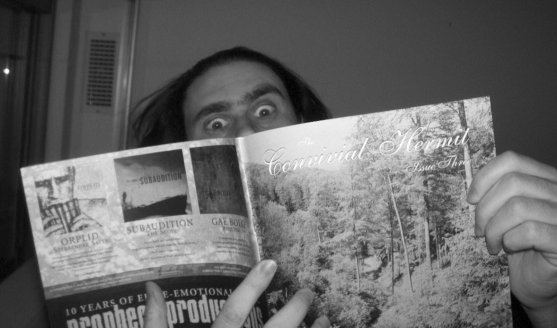
Is black metal dead as a legitimate style? What do you think of its current state and how do you see it developing in the future?
Black metal cannot be dead since there are more black metal bands today than ever before. Whether I care for most of these bands is another question…
Black metal in its current state as a “movement” or a “scene”, though, is pretty worthless, I think. The deluge of bands in recent years with the popularity of Myspace has proven that it does not take significant brainpower or imagination to create a black metal band. And yet the style persists as a viable medium that excites people and that people can relate to. People are interested in the style. Myself, I love black metal about as much as I have in the “old days”, but the frequency of quality discoveries for me has dropped dramatically over the last few years. Most metal I hear today I tend to either sell or trade almost immediately, since the recordings are usually so totally unoriginal or flat on emotion. I really dislike thin-sounding digital productions, also. It is very hard to find newer bands of any value when you have to sort through a thousand poor ones, or poorly recorded ones, but they are certainly there. Just recently I picked up a few decent bands, Forteresse from Canada, Walpurgisnacht from Holland, Rift from Australia is really good, the new Kerbenok double-CD is great... so there is still good black metal but finding it has become a chore. I don’t know how I still do it... I must be insane to spend so much time sifting through so much shit! But that’s in the nature of this music and this culture: when you love it, you love it with all your heart. There is no compromise.
What will happen in black metal in the future? It’s frightening to think of... I think we are seeing a transition today in style. This decade will be remembered for the confluence of bedroom black metal bands, for certain! Drum machine black metal will also be the defining mark of this decade, the 00’s or however you want to call it. This new wave (drum machine bands, one-member bedroom black metal) hasn’t existed in the 90s... or barely. Yet now it’s everywhere. Black metal has reached some kind of strange boiling point today where the ideas of leading bands are getting recycled into more of the same ideas, and then recycled again, and then recycled once more. It really demonstrates the postmodern idea of the simulacra! Will this lead to innovation in the end? If you ask me, only insofar as a simulacra can count as an innovation, or a meme travelling through the space of brains, evolving as its does so, can constitute a new innovation...
Honestly, no one really knows what is coming up next but the artists themselves. I’ve stopped asking that question long ago, as it is so unpredictable. I just concentrate on searching for good, powerful music, just as I have since this passion manifested itself, regardless of the politics involved, and regardless of what’s happening around me with tastes and fashions and so on. Most of the music that I value just happens to be of the metal genre, as that is the genre that I tend to be affected by the most, that I feel the most from...
Well you said that a lot of bands have been folding the styles of the founders back in on itself over and over again. But what do you think of the stylistic expression of regression of bands. A really good example of what I mean would be Darkthrone and how they have been regressing towards the roots of the style ever since Transilvanian Hunger rather than creating something as genre defining as TH. Also what do you think of bands that started with Corpse paint and then matured out of the use of this aesthetic?
I’m not “opposed” to regression in music, but I am very much opposed to cliché. There are such things as form and content. Regardless of what form you choose to work with, if it has no content, or if the content is weak, then the form will not redeem itself. The best artists are those who master and create their own form. But it is unrealistic to expect every band to achieve these traits. I have talked to my former colleague Umesh Amtey about this many times, and I think this is part of the reason why we were able to work together for so long. It is generally rare, this mastery and idiosyncracy of form. Sometimes an artist comes about that explores and finds new passages in a style that has already been played out and established, and the result can be quite excellent. Take the so-called Burzum clones, for example… Nyktalgia, Abyssic Hate, Wigrid, (earlier) Drudkh... obviously these artists are all highly influenced by Burzum, but their music is still great and, I would argue, even unique in certain aspects. Those are good examples of artists who make up what they lack formally.
Corpse paint has never really been all that important to me. I understand the meaning behind it and I definitely enjoy it, but the mystique around this aesthetic has faded considerably, especially since BM bands started relying upon professional photo sessions. The bands that have begun using it and then have stopped are, I think, making a statement, whether they like it or not. Usually the statement is, “Here I am, I am mature now, since I don’t use these gimmicks”. But what’s funny about these guys who consciously remove the corpse paint is that the poses are pretty much the same, just without the makeup.
Generally speaking, I like anything unusual and unearthly, anything breaking away from the common conventions. Corpse paint is nice since it imbues a certain otherworldliness or aura to a band, but is it really important to me, or do I think it’s absolutely necessary for black metal to be black metal? No, not at all...