Interview
with
Funeral Fornication 2010
By
Bradley Smith
 Is
your new album, Pandemic
Transgression finished yet? Can you describe the progression you have
made
since Solitude and Suicide? How do you feel you have developed not just
the
music but the philosophical and emotional foundations of Funeral
Fornication in
this time period?
Is
your new album, Pandemic
Transgression finished yet? Can you describe the progression you have
made
since Solitude and Suicide? How do you feel you have developed not just
the
music but the philosophical and emotional foundations of Funeral
Fornication in
this time period?
It
is nearly finished, a bit more recording needs to happen, then the
mixing stage. There has been quite a bit of progression since Solitude
And
Suicide. With that album, I was diving into unknown waters with a new
sound for
Funeral Fornication, and I was not sure what the public response was
going to
be. Fortunately, it has been quite positive. Now I feel that with
Pandemic
Transgression I can take this project to the next stage of its
evolution. The
sound you heard on Solitude And Suicide returns, only this time with
additional
elements. There are clean singing vocal parts, which are something I
used to do
on older Funeral Fornication demo material, and the songs are a bit
more
progressive. Also, I think Pandemic Transgression is the most ambitious
and
grandiose undertaking of Funeral Fornication to date. As for the
philosophical
and emotional foundations of Funeral Fornication, I think the message
or
emotional stance is never stationary. For example, I may have two or
three
different songs that are trying to convey, and are inspired by, two or
three
different emotional states. By exhausting my own emotional palette
through the
musical and lyrical ideas, I am hoping to spark the listeners’
emotions. In a
way, I intend Funeral Fornication to act as a mirror, leaving the
listeners to
decide their own emotions and philosophy. I am not trying to convey a
philosophy of any sort. Depressive black metal isn't about a philosophy
to me. It’s
about depression and all the levels of it as explored from an artistic
angle. I
leave the philosophy to the NSBM groups.
On
Pandemic Transgression you
composed the lyrics first. How does that affect your approach to
writing and
arranging the song? Do you find this a more constraining approach to
songwriting
than writing the music first? Why or why not?
Ummmm...actually
if you re-read the interview you read that in, you'll see
that i stated that for Pandemic Transgression I wrote the music first.
I find
the process of writing the music first more freeing as I can be more
experimental. When I wrote lyrics first, it was too easy to fall into
the trap
of holding back the music and limiting it to a predictable song
structure. I
feel that now I am able to delve deeper musically into the ideas I am
putting
forth, and really take the listener on a journey.
As
you put it, black metal is
“the most primal and emotionally violent side of human nature released
through
the medium of music.” When you visualize primal urges in the context of
black
metal, what do you mean? Do you not believe there is a
philosophical/spiritual
element to black metal?
When
I said "the most primal side of human nature", I was
referring to a more reptilian way of thinking. Kill or be killed, no
morals, no
conscience. Raw aggression through the medium of music. Although I
agree that
some may hold a certain philosophy or spiritual belief behind the
music, for
myself, I merely use black metal as an emotional outlet. Black metal
means
something different to everyone who likes it.
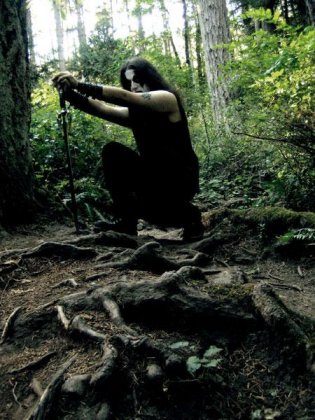 Based
on the pictures you have
had taken and what I have seen of British Colombia, Canada it seems
there are
vast amounts of Natural beauty on display. How has living in this
environment
affected your development as an artist and what does nature mean to you?
Based
on the pictures you have
had taken and what I have seen of British Colombia, Canada it seems
there are
vast amounts of Natural beauty on display. How has living in this
environment
affected your development as an artist and what does nature mean to you?
Nature
holds a great beauty to me, that at times inspires a lot of my
music. "The Weeping Tree" off Solitude And Suicide is a good example
of this. I was walking through a dreary meadow on a cloudy day and came
upon a
creepy looking tree that was void of leaves. It was truly a depressive
yet
beautiful sight, and I wanted to recapture the feelings it gave me and
"The Weeping Tree" was the result. This is one time out of many that
I've been inspired in this way, so I guess you could say that living
where I
live has affected my artistic development quite a bit, but definitely
in a
positive way. Nature to me means escape from the things of man. I find
I write
some of my best material when I go away camping for the weekend, and
get out of
the city.
Many
trains of thought can be
started with the words “mankind as a disease.” How do view this in
relation to
your music and what is the logical conclusion to man’s existence? Or do
you
think that in general our fate is unknowable?
Hmm...interesting
question. "Mankind as a disease", of course
being the theme of Pandemic Transgression. The journey that I take the
listener
through on the album ends with the destruction of the self, which is
inevitable
because even the speaker is part of humanity, ergo part of the disease.
I think
all black metal has a degree of misanthropy to it. It goes without
saying that
the idea of hatred towards humanity is a crucial element in black metal
in
general. I think its fair to say that a lot of the themes I've used
since the
inception of Funeral Fornication perpetuate the idea of hatred for
humanity. As
for the fate of man, I think in the end our fate lies inevitably with
self-destruction.
I
read in an interview that you
are opposed to the elitism within black metal that occasionally rears
its head.
Why do you think there is this pull for some bands to be elitist and
why do you
dislike elitism within the scene?
I
honestly have no idea why so many bands choose this elitist attitude.
There is no reason for it, and taking that stance achieves NOTHING. I
understand the idea that black metal began as a revolution against the
music
industry, and that over the years it became commercialized and watered
down to
some degree, and I suppose the elitist bands are trying to preserve the
original idea of black metal, but quite frankly, I don't hate the music
industry so much that I'm going to waste my time playing in a band that
I
intentionally don't want to have people be aware of. I guess that makes
me not
"underground"? I will continue to play the form of black metal I
enjoy, and if I am considered to be false black metal or whatever by
the
elitists, I couldn't really give a shit. The only thing I have against
the
elitists is that their plight is getting old, repetitive, and boring.
No one
cares anymore what black metal started out as. If people took that
attitude
towards metal in general, we'd all sound like Black Sabbath.
What
was the oddest thing that
ever inspired a musical or lyrical composition for you? What is your
primary
inspiration for your art? And what atmospheres and emotions have the
strongest
pull on you when you are focusing on your artistic creation?
My
inspiration often comes from within. Sometimes I will remember a dream
I had and write a song about it, or I will just start writing, and see
where my
mind takes me. Outside of that, nature inspires me quite frequently.
Those are
the primary sources of my inspiration. I've also been inspired by
movies, other
bands, classical music, even memories from my past. I don't suppose any
of that
is really odd though. When writing depressive black metal, the
atmospheres and
emotions I generally cling to when writing are quite rightly the more
negative
ones: Anger, melancholy, rage, shame, sorrow, pain, suffering, utter
defeat,
and of course, depression.
With
the death of Ronnie James
Dio you mentioned that you Shared the grief of his family at his
passing. How
does one share grief? I mean how does an event unite us disparate
humans and
what in particular is so unifying about grief? Are there any other of
metal’s
stars that you have mourned?
We
as a species for some strange reason tend to unify in the face of grief
rather than in the face of joy...which is something I find very
interesting,
because I think it grows out of a subconscious worship of death. Dio
has always
been a huge influence to me, and I was very sad to hear of his passing.
I tend
not to mourn the deaths of fallen metal brothers, although I am sad
they are
gone, and have sympathy for their loved ones. Rather I find it a
tragedy that
their music is dead. I felt the same way when Chuck Schuldiner and
Quorthon
died. And as for sharing the grief of Dio's family, I wasn't only
speaking for
myself. The man had fans worldwide that worshiped him. He will be
mourned by
all of them.
I
noticed that one of your
influences for Funeral Fornication is existentialism and wondered how
you
thought a philosophy that centered on man’s existence as an individual
played
into another influence of yours, the mentality of suicide and suicide
itself.
What about these two intertwined themes appeals to your creative
output?
I
am often amused by human mentality. Existentialism to me is designed to
build up an individual’s self-confidence, as it declares that it is up
to the
individual to give their own life meaning, thereby removing the idea of
God
from the equation. This indirectly gives the individual a sense of
being their
own god. Existentialism promotes the vanquishing of emotions such as
despair
and anger, and living your life as passionately as you can. Now, on the
opposite side of the spectrum you have the concept of suicide. Suicide
is a
unique topic because it is an inherently unique decision: To
voluntarily end
one’s own life. The irony of existentialism is that there are some who
cannot
handle the idea of an absurd universe void of God, and when given the
idea that
they are responsible for their own life's meaning, find it too enormous
a
concept to accept...and then entertain thoughts of suicide, unable to
accept
the enormity of their lives. Perhaps I am stretching that a little far,
but in
the end I find the idea of one gaining power of mind from being their
own god,
and the idea of an individual feeding the negative emotions that lead
to a
suicidal mentality, opposite though neither one void of lyrical
inspiration.
These two concepts have been two things I've studied in my leisure and
written
songs about, but it would be more apt to say that human mentality in
general
has been a bigger factor in my creative output.
 While
we are on the topic, could
you ever see yourself committing suicide? Do you find it in general a
“romantic” concept? I mean is the act an idealized statement for you
that
transcends the mere killing of oneself? Or is it just a flat act where
everything about it lays upon the surface?
While
we are on the topic, could
you ever see yourself committing suicide? Do you find it in general a
“romantic” concept? I mean is the act an idealized statement for you
that
transcends the mere killing of oneself? Or is it just a flat act where
everything about it lays upon the surface?
Could
I ever see myself committing suicide? Not at the moment. I don't
find suicide a romantic concept, but rather I am attempting to portray
it, and
death, as a romantic concept. What interests me is what causes one to
decide to
kill one's self. What goes through an individual's mind when they were
preparing their own death. The act of suicide is simply what it is.
It’s the
events leading up to it that interest me.
You
are active in several other
projects, can you tell me which ones and what activities these projects
are
involved in currently? What are your upcoming plans for Funeral
Fornication
besides the new album?
I
am in ARTEP, and we are currently preparing material for our second
full-length album. Our first has just been released. ARCHSPIRE has just
completed recording our EP, "All Shall Align", and we'll be going on
tour in July. Other than that, I plan to promote the new Funeral
Fornication
album, and as always continue writing new material. There will also be
A
Funeral Fornication split release with Uruk-Hai from Austria
forthcoming.
I
will leave any final words of
atavistic regression to you.
Thanks
for the interview, and keep listening!