Interview
with Ola of Griftegard 2010
By Bradley
Smith
 Your album
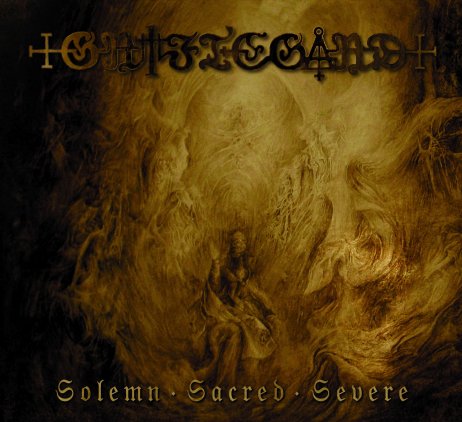
Solemn.Sacred.Severe. is a doom masterpiece of sorrow, anguish and doubt. Can
you describe its creation and what it took to pour your creativity into it? What
themes are you trying to convey with the album?
Your album
Solemn.Sacred.Severe. is a doom masterpiece of sorrow, anguish and doubt. Can
you describe its creation and what it took to pour your creativity into it? What
themes are you trying to convey with the album?
Thank you for this favourable description of our work. The creation of the album
is hard to sum up cohesively as all its different parts (lyrics, riffs, ideas)
has manifested themselves during a time span of more than ten years (some of the
oldest riffs actually date back to when I first picked up the guitar).
Griftegård started out in 2005 though (with me and my fellow guitarist Per as
founding members – Per had been with me in another Doom band called The Doomsday
Cult between 01-04) and in 2007 we released the Psalmbok demo/EP and a tribute
song to Pagan Altar (on Metal Coven’s Knock em´down to size 7” Doom Metal
sampler). Then the band went into a long hiatus due to my commitments towards my
former record label I Hate. I came up with a lot of riffs and ideas on my own
during this time though, but it wasn’t until I quit the label in mid 2008 that
writing and rehearsing of what would be SSS started seriously, together with the
other members. While the greatest part of the riff’s and ideas are mine (as well
as all the lyrics) I can safely say that without the great experience of the
other members the album would sound nothing like it does. We rehearsed quite
intensively between autumn 2008 and late winter 2009 and started recording in
March 2009. In the process we had to relieve our bass player Robert from his
duties and in came our current bassist Thomas Jansson (on very short notice) and
made a fantastic job. The recording was complete in July 2009 and the album was
released in Europe in September. These are the hard facts regarding the creation
of the album. Regarding a description of what it took to pour our creativity
into the album I think it is correct to say that during the period previously
mentioned we lived and breathed Griftegård. Also, in the middle of the
recording, which had to be carried out during weekends due to our day job’s, we
went on a mini tour of Germany and Switzerland, and it then became evident that
things had become perhaps too intense. Without revealing too much I can say that
the tour ended in a debacle. Back home the recording continued regardless and in
the end I believe we made our outmost to make the album what it is – a solemn,
sacred and severe Doom Metal experience.
Among the themes conveyed there is contempt (for the base, shallow existence
most people mistake for life), longing (for greater understanding and meaning),
sorrow (for the failure of reaching understanding and meaning and for the loss
of faith/illusory enlightenment) and doubt (whether there is any meaning of
understanding at all).
What is an
apostate Jehovah’s Witness? I mean what separates it from normal a normal
Jehovah’s Witness? How do you feel that influences your approach to lyric
writing? And can you talk a little bit about the inspiration for the song
Charles Taze Russel?
The definition of an apostate is a person that renounces and criticizes his/her
former religion I believe, and I may have used the term a bit loosely
before...This said I think the description of myself as an apostate Jehovah’s
witness is correct to some extent as I, like anybody who has been deeply
religious, always will carry with them parts of his/her old indoctrination, no
matter how secular they may appear to the world. The influence the JW
indoctrination has had on my creativity is big, no doubt. Through my lyrics I
have channeled a lot of the anxiety and anguish from past experiences within the
sect. The JW’s made me to who I am today, to a large extent (for good and for
bad) and who I am, my world of thought, naturally comes through in my work. Some
of the inspiration for Charles Taze Russel comes from reliving my childhood
fear, and longing, for Armageddon and the end of the world. Also it is a biased
tribute to the man who started it all.
With
Griftegard I seem to find a strong focus on the vocals, filled with Anguish and
doubt, as opposed to some of the more “traditional” approaches. Do agree and how
do you view the emotional qualities as they relate to your music? I mean which
emotions are central to Griftegard’s character?
Thomas Ericksson and I have a strangely symbiotic relationship – after just a
cursory glance at my lyrics he seems to instinctively feel what I want to
convey, and is able to express this vocally as well. Of course I explain the
lyrics to him thoroughly, though in reality I don’t need to, because he knows
what I’m after anyway. If the result is an unorthodox vocal delivery or not is
up to the listener to determine, it is not something we actively pursue. I can
only say that if Thomas, for some reason, would quit Griftegård it would be the
end of the band – no one would be able to replace him, regardless of vocal range
or charisma. If I would pick only two of the emotions that are central to
Griftegård it would be longing and sorrow, in equal measures. However there are
fleeting moments of insight and light to find in here as well, at least before
doubt kicks in.
4. There is a
strong heritage for Swedish doom which includes Candlemass and Count Raven and
now yourselves. How do you view yourself in relation to this legacy and do you
draw any inspiration from it?
We do not limit our view of Griftegård to a national perspective; music is
universal and independent from geographical location. There’s no denying however
that Candlemass and Count Raven has inspired at least myself greatly during the
years.
I read you have
lost your faith and are trying to fill that void. What caused you to abandon
your religion and what are you using to fill that whole left behind?
When I was 13 years of age my parents left the JW’s, which lead to me leaving
the sect as well - it took me over a year to do so though, their indoctrination
and continuous attempts at persuading me to stay was hard to resist. There is no
specific thing or occurrence that I can point out that made me lose faith
though, it came gradually. There’s one thing I remember though, a vision of
sorts that I had – I must have been around 15 at the time: before my inner eye I
actually saw and felt how God’s face was turned away from me, his ear turned
deaf to my prayers, his light no more shining upon me. This may sound clichéd
and melodramatic to some but it was quite real to me and I will never forget it.
Reviling man
for his behaviour in this realm seems a little absurd to me because man’s
behaviour during his existence as it applies to this realm is what makes man,
man. I mean being subjected to the urges of his nature make him essentially
human or do you disagree? I mean why even be here if not to experience what life
has to offer?
Being subjected to, and responding upon, the urges of one’s “human” nature is of
course what generates what we in general call human behaviour. However, to
determine whether or not there is any use in questioning man’s behaviour one
needs to define what it is to be Human with capital H. Many people identify with
their human body and take all its (“their”) needs for granted and see no meaning
in questioning them. To me these people are enviable in the same way that
animals are. This said I do not say one should forsake all earthly things and
just occupy oneself with matters of spirit, I am no monk, far from it, but some
reflection and introspection is in order or else there certainly is no use being
“here”.
Reading some
other interviews I noticed a strong prevalence towards the themes of duality and
paradox within your own philosophies. How do you manage to merge the ideas of
spirituality with an earthly existence? And how do you assimilate opposing
themes within your lyrics such as triumph and defeat, doubt and faith? Do you
view your life as a sort of contradiction? Are you constantly struggling with
your self? Do you think your views are reflection of the religious
contradictions you have been taught, such as an all-loving god who is also cruel
and unforgiving?
If we try to be honest to ourselves we will all realise that everything we do
contains paradoxical elements and that everything around does as well, that’s
just life, in this realm. I think that only autistic persons (perhaps prejudice
from my side) or the fanatically religious (certainly no prejudice from my side)
may be free from doubt.
Yes, I am constantly struggling with myself, for good and for bad (here we go
again...) and I think everyone ought to. Look upon each new day as another round
upon the dissection table of the mind and you’ll be one day closer to grasping
who you are, and who you really want to be.
 One thing about
doom metal is that I feel with the pace of the songs, the riffs are able to
breath and land with a strong emotional impact. Do you agree? How do you feel
about the guitar’s role in Doom as opposed to other forms of metal?
One thing about
doom metal is that I feel with the pace of the songs, the riffs are able to
breath and land with a strong emotional impact. Do you agree? How do you feel
about the guitar’s role in Doom as opposed to other forms of metal?
I agree totally in what you say, riffs played slowly resound louder within when
singled out in the relative silence-between-strokes-serenity that is real Doom
Metal. There truly is strength in the minimal, just listen to Arvo Pärt, or
Darkthrone… The guitar riff is central to me, and to all our songs, as it is
from the riff-seed the instrumental elements of the song branches out. The
inception of every Griftegård composition is to be found in a riff that has got
“it”. The guitar in Doom Metal doesn’t stand in opposition to the guitar in
other forms of Metal – if the guitar riffs aren’t good the songs are not good,
no matter if it is Black, Death or Mongo- whatever - Metal imo. This said I can
enjoy other kinds of music that has no actual riffing, like harsh noise (perhaps
better to brand this anti-music, but anyway) and certain ambient stuff, for
example. Metal in my book is about the Guitar RIFF though.
What are some
of your upcoming plans for Griftegard? Any new music or performances on the
horizon? What is happening with the Count Raven split you have coming soon?
The Count Raven split is out since a month or so (today is October 2-2010) and
is apparently selling well for our label. Also I have just finished the layout
for our split 7” with Lord Vicar. This one will feature a new song of ours
called A Deathbed For All Holy and is, by our standards, a fast song, with very
simple but effective RIFFING. Our brothers in Lord Vicar contribute with a cover
of the Cardigan’s song Do You Believe? Our song is yet to be mixed and mastered
while I believe theirs is ready. On the 22nd and 23rd of
October we will play Germany, first date will be with our label mates
Vanderbuyst and Burden in Cologne and the second is on Hammer Of Doom in
Wurzburg with Solitude Aeternus, Sorcerer and Jex Thoth among others. Once this
has passed we will concentrate on finishing our next full length, for which two
songs are more or less finished.
I leave any
final words of illumination to you…….
Thanks’ a lot for your support.
For Griftegård merch go to:
http://www.van-records.de/
http://www.myspace.com/griftegrd